
How many times have you blended your foundation perfectly in your bathroom mirror, only to step outside and realise your face is a different colour to your neck? The culprit is almost always poor lighting. Most home bathrooms rely on overhead or single-point lighting, which casts harsh shadows across your face and distorts colours.
Enter the LED lighted makeup mirror—but not all are created equal. The technical specification that truly separates a good mirror from a great one is brightness levels, measured in lux. Many shoppers chase high numbers like 1100 lux, assuming brighter is always better. However, as this guide will reveal, what delivers a professional, flawless finish is not just raw lux but even, shadow-free light.
In this comprehensive Australian guide, we will demystify every technical detail: what lux really means, how much you need for different tasks, why colour rendering index (CRI) and colour temperature are equally critical, and whether you should invest in a high lux mirror or one with adjustable dimming. By the end, you will know exactly how to choose the perfect illuminated mirror for your vanity.

Demystifying the Technical Specifications: Lumens vs. Lux in Makeup Mirror Lighting
Let’s clear up one of the biggest points of confusion in the lighting industry: lumens vs. lux.
-
Lumens measure the total amount of light emitted by a source (your mirror’s LED bulbs). This tells you how “bright” the bulb is.
-
Lux measures the amount of light that actually reaches your face. It accounts for distance and how the light spreads.
Why does this matter? A mirror might advertise 2000 lumens, but if the LEDs are poorly positioned or too far from your face, the illuminance on your skin could be as low as 200 lux. For makeup application, lux is the only metric that matters.
For context:
-
A dimly lit office: 50–100 lux
-
A standard bathroom: 150–300 lux
-
A professional makeup studio: 500–1000 lux on the face
When reading lighted mirror specifications, look for the lux value stated at a standard distance (e.g., 30 cm or 12 inches). Reliable Australian brands like AMIRO and Peroz often provide this data. Ignore vague claims like “ultra-bright” – demand the technical specifications, especially illuminance levels in lux.
The Goldilocks Zone: What Is the Ideal Lux for Everyday and Professional Makeup?
So, how much lux do you really need? The answer depends on how you use your mirror.
Based on the Chinese national standard (GB 50034) – widely adopted in LED mirror manufacturing – and advice from professional makeup artists, here is the Goldilocks zone:
| Use Case | Recommended Lux | Why |
|---|---|---|
| Basic grooming (teeth, hair, shaving) | 150 – 300 lux | Enough to see shape, not detail |
| Everyday makeup (foundation, concealer) | 300 – 500 lux | Avoids eye strain, natural blending |
| Detailed makeup (contour, eyeliner, brows) | 500 – 750 lux | Reveals texture, edges, and minor errors |
| Professional studio / colour-critical work | 900 – 1100 lux | Mimics daylight for flawless photography |
Going above 1100 lux without proper diffusion can cause glare, eye fatigue, and harsh shadows. The sweet spot for most home users is 500–750 lux. This range gives you professional-grade visibility without discomfort.
What about the 1100 lux professional makeup mirrors you see advertised? They are excellent for makeup artists working in controlled studio environments where the mirror is positioned precisely 18–24 inches away. For a typical home vanity with variable seating distance, 700–900 lux is often more practical.

Colour Temperature (Kelvin) and CRI: The Unsung Heroes of Accurate Makeup Mirror Lighting
Brightness alone cannot guarantee a perfect match. You have probably noticed how your foundation looks orange under warm bathroom lights but perfect in daylight. That difference is governed by colour temperature and colour rendering index (CRI) .
Colour Temperature (Measured in Kelvin)
-
Warm light (2700K–3000K): Yellow/orange tones. Makes skin look more pigmented; hides redness but distorts true colour.
-
Neutral light (4000K–5000K): Balanced, like overcast daylight. Ideal for makeup because it reveals both warm and cool undertones.
-
Cool light (6000K+): Blue-ish, clinical. Highlights every imperfection but can feel harsh for extended use.
Recommendation: Choose a makeup mirror colour temperature between 4000K and 6000K. The most popular choice among professionals is 5000K – often marketed as “natural daylight.”
Colour Rendering Index (CRI)
CRI measures how accurately a light source reveals the true colours of objects, compared to natural sunlight (which has a CRI of 100). For makeup application, you need CRI ≥ 90. Many budget mirrors use LEDs with CRI 70–80, which will make your skin look flat and muddy.
Professional tip: Look for R9 value (saturated red rendering). Skin contains a lot of red and pink tones. A high R9 (above 50) ensures your blush, lipstick, and any redness or rosacea appear correctly. Premium mirrors like simplehuman and AMIRO advertise CRI 95–98 with strong R9 values.
Without high CRI, even 1100 lux professional makeup lighting will mislead your eyes. Invest in both lux and colour accuracy.
Why Even, Shadow-Free Light Outranks Raw Brightness in Lighted Makeup Mirrors
You can have a mirror that delivers 1200 lux directly in the centre, but if the light comes from a single source above your head, you will see deep shadows under your chin, nose, and brows. Those shadows will cause you to over-blend or miss patches of concealer.
Even, shadow-free light is non-negotiable. Here is the technical breakdown:
-
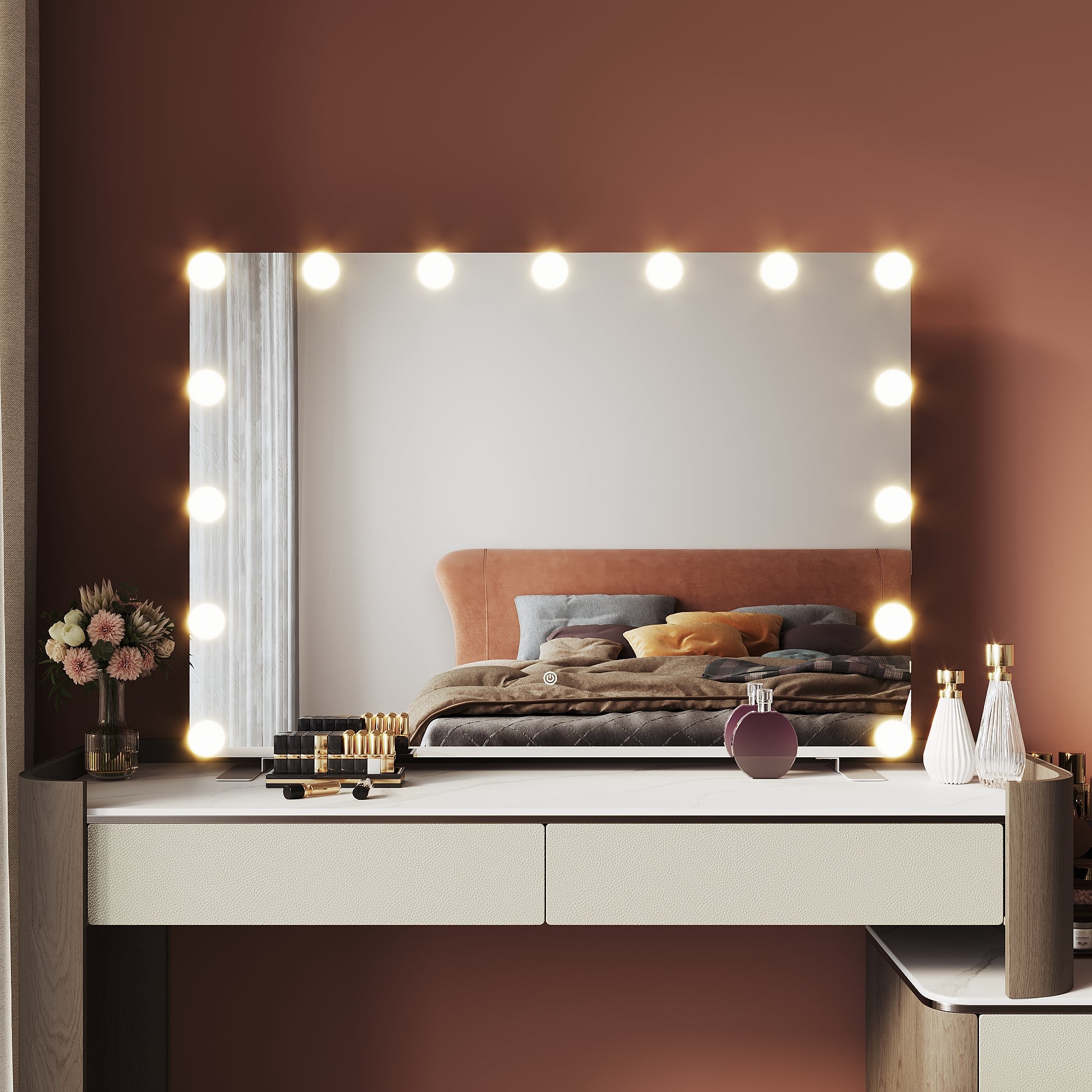
Front-lit mirrors (LEDs around the reflective surface, pointing outward) project light directly onto your face. This is the best design for shadow reduction.
-
Backlit mirrors (LEDs behind the mirror, casting light onto the wall) look stylish but are terrible for makeup application. They illuminate the wall, not your face.
-
Side-lit vertical lighting (LED strips running down both sides) is excellent because it mimics professional dressing room lighting, eliminating shadows from all angles.
How to Assess Light Uniformity
Check the LED density (number of LEDs per metre) and whether the mirror uses a diffuser. A frosted or opal diffuser scatters light evenly, preventing harsh hotspots. Look for a uniformity ratio (minimum illuminance ÷ average illuminance) of ≥0.6.
In short: A mirror with 500 lux, even distribution, and excellent diffusion will outperform a 1100 lux mirror with uneven, glary hotspots every time. Always choose shadow-free light over raw brightness.

High-Lux Mirrors vs. Adjustable Dimming: A Critical Comparison for Australian Buyers
The High-Lux Philosophy (Fixed Brightness)
Brands like AMIRO (up to 1100 lux) and simplehuman (up to 1400 lux with sensor technology) argue that professional work requires maximum, consistent brightness. These mirrors are excellent for:
-
Makeup artists with a fixed, calibrated seating position
-
Photographers or content creators who need repeatable lighting
-
Users who always apply makeup in the same room with the same ambient light
Downside: If you suffer from light sensitivity or apply makeup in the evening when your eyes are tired, 1100 lux can feel painfully bright.
The Dimmable Philosophy (Adjustable Brightness)
Mirrors with stepless dimming (e.g., NuBrilliance, Peroz, many Amazon AU models) allow you to slide from 100 lux to 1000+ lux. Benefits include:
-
Morning vs evening: Use high lux for detailed day makeup, lower lux for gentle skincare application.
-
Reduced eye strain: You can find your personal comfort threshold.
-
Versatility: Ideal for shared bathrooms where one person does detailed makeup and another just shaves.
The Verdict for Australian Homes
For most home users, adjustable dimming is superior. It gives you the flexibility to adapt to changing ambient light conditions (bright summer morning vs dark winter evening) and different tasks. A fixed high-lux mirror is best reserved for dedicated professional stations.
When comparing Australian retailers like Sephora Australia, Peroz Australia, and Amazon AU, prioritise models with stepless dimming, CRI ≥90, and a lux range of at least 100–800 lux.
How to Read a Lighted Makeup Mirror’s Specification Sheet: Lux, CRI, Lumens, and More
Not all product listings are honest. Some use “lux” to describe the LED chip brightness rather than the actual illuminance on your face. Use this checklist when evaluating a lighted mirror specifications sheet:
| Specification | What to look for | Red flag |
|---|---|---|
| Lux (at face) | Stated at a specific distance (e.g., 700 lux @ 30 cm) | “Up to X lux” or no distance given |
| CRI | ≥90 (95+ ideal) | CRI <80 or not listed |
| R9 value | ≥50 for skin tone accuracy | Not mentioned |
| Colour temperature | 4000K–6000K (5000K ideal) | Fixed warm (3000K) without adjustment |
| Uniformity | Diffuser present; even light visible in photos | Visible individual LED dots or hotspots |
| Dimming | Stepless, from <10% to 100% | Only 2–3 fixed levels |
| Flicker | Flicker-free driver | Camera shows pulsing on phone video |
Pro tip: If a product page only says “bright” or “natural light” without numbers, assume the technical specifications are poor. Reputable brands always publish lux, CRI, and Kelvin values.
Frequently Asked Questions (FAQs): Everything Australian Shoppers Ask About Makeup Mirror Brightness
Is 1000 lux too bright for a makeup mirror?
Not if the light is well-diffused and you are working at a distance of 45–60 cm. However, for most home users, 1000 lux can cause glare and eye fatigue over a 20-minute session. 500–750 lux is the ideal range for comfort and detail.
What is the difference between 1100 lux and 500 lux makeup mirrors?
1100 lux mirrors are designed for professional makeup artists who need to see absolute colour accuracy and every pore. 500 lux mirrors are sufficient for daily home use, especially if they have high CRI and even distribution. The higher lux does not automatically mean better – evenness matters more.
Are backlit mirrors good for doing makeup?
Generally, no. Backlit mirrors project most of their light onto the wall behind the mirror, not onto your face. For makeup application, you need front-lit or side-lit designs with LEDs pointing toward you.
What is the recommended brightness for an LED makeup mirror in lux?
-
Basic grooming: 300–500 lux
-
Detailed makeup: 500–750 lux
-
Professional studio: 900+ lux
What size lighted makeup mirror should I buy?
-
Compact travel: 6″–8″ diameter
-
Small vanity: 13″×17″ (fits most Australian apartment bathrooms)
-
Large professional desk: 19″×22″ or larger (e.g., 22″×32″ for double vanities)
Conclusion: The Final Verdict on How Much Lux You Really Need in a Lighted Makeup Mirror
We have covered a lot of technical ground. Here is the bottom line:
-
Lux matters, but only up to a point. Target 500–750 lux for detailed home makeup. Only professionals need 1100 lux.
-
Even, shadow-free illumination is more important than chasing high numbers. Prioritise front-lit, diffused designs with high LED density.
-
CRI ≥90 and colour temperature of 5000K are non-negotiable for colour accuracy. Do not buy any mirror that hides these specifications.
-
Adjustable dimming offers superior flexibility for Australian home users, allowing you to adapt from morning brightness to evening gentleness. Fixed high-lux mirrors are best for dedicated studio setups.
Your makeup mirror is not a vanity accessory – it is a precision tool. By understanding brightness levels in lighted makeup mirrors and the true meaning of lux, you will never again step out with mismatched foundation or uneven contour.
Ready to find your perfect match? For a curated selection of high-performance LED makeup mirrors, stylish vanity mirrors, and complete bathroom lighting solutions tailored to Australian homes, visit Elegant Showers at https://www.elegantshowers.com.au. Explore our range of dimmable, high-CRI mirrors and discover professional-grade ideas to elevate your daily beauty routine.