
Quick answer: An imported shower screen is not automatically unsafe—but it is not automatically compliant with Australian glass standards either. Safety depends entirely on two things: whether the glass carries a permanent AS/NZS 2208 mark and whether the installation satisfies AS 1288. A screen that looks identical to an Australian-made product can still shatter, void your insurance, and fail a building inspection if it has not been tested to the Australian protocol. This guide explains both standards, why overseas certification often falls short, and exactly how to verify an imported screen before you install it.

What Makes a Shower Screen “Safe” Under Australian Law?
“Safety glass” is not a single product—it is a performance classification, and in Australia that classification is legally enforceable.
The National Construction Code (NCC) mandates safety glazing in bathrooms because shower screens sit within the human impact zone: wet floors increase the likelihood of slipping into glass, and hard surrounding surfaces amplify the consequences of breakage. The NCC calls up two standards in tandem:
-
AS/NZS 2208 governs the glass material itself—fragmentation, impact resistance, surface compressive stress, and permanent marking.
-
AS 1288:2021 governs how that glass is selected and installed—thickness, support conditions, panel sizing, and fixing method.
The default requirement for shower screens is Grade A safety glazing material—either toughened (tempered) glass or laminated glass. Annealed glass is prohibited in shower enclosures regardless of thickness. A screen that does not meet these standards is not merely a poor purchase; it is a non-compliant building element that can void insurance, fail a building inspection, and create personal-injury liability for the importer and installer.

AS/NZS 2208 Explained: The Glass Performance Standard
AS/NZS 2208 sets the material performance bar for safety glazing. For an imported shower screen to be compliant, the glass must pass four tests and carry the correct marking.
Fragmentation test. When toughened glass breaks, no fragment may exceed 10 cm². Instead of razor shards, compliant toughened glass shatters into small, blunt cube-like granules—“pebbles” that significantly reduce laceration risk in a wet-area fall. This is a pass/fail test, and it is the single most important performance distinction between safety glass and ordinary glass.
Surface compressive stress. Grade A toughened glass must achieve a minimum surface compressive stress of 90 MPa, with edge stress of at least 67 MPa. This internal tension is what makes toughened glass four to five times stronger than annealed glass of the same thickness. If the stress is below the threshold, the glass may look toughened but will not perform like it.
Impact resistance. AS/NZS 2208 requires pendulum and drop-ball testing using defined striker masses and heights, including edge testing that simulates the hinge and clamp collisions that happen in real bathrooms.
Permanent marking. Every compliant pane must carry a permanent legible mark—etched, sandblasted, laser-etched, or ceramic-fired into the glass—showing the AS/NZS 2208 reference, the manufacturer or supplier, and the production batch. A printed label or a sticker that can be peeled off is not sufficient for audit purposes. The mark is commonly placed low down near a corner so it does not interrupt the view.

AS 1288:2021 Explained: The Installation and Thickness Standard
AS 1288 is the selection and installation standard; AS/NZS 2208 is the material standard. Both must be satisfied, and passing one does not compensate for failing the other.
AS 1288:2021 sets minimum thickness rules based on how the glass is supported:
-
Framed toughened glass: 4 mm minimum.
-
Partly framed or frameless toughened glass: 6 mm minimum.
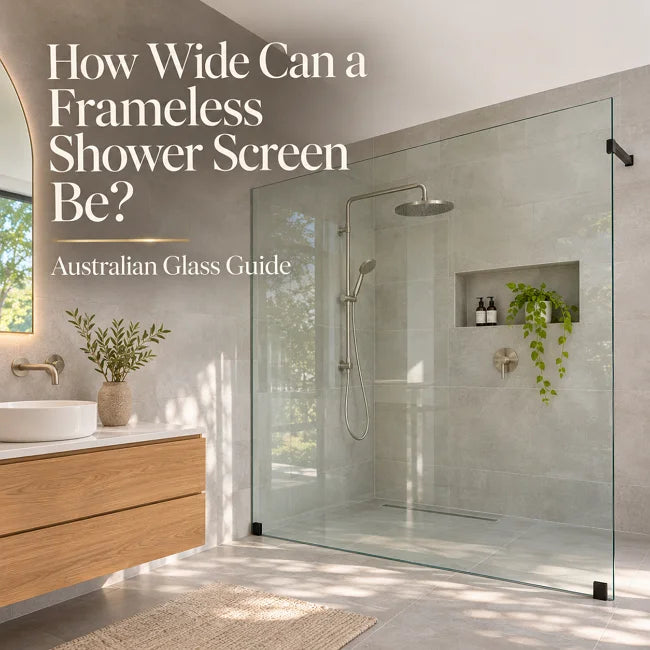
In practice, semi-frameless screens commonly use 6 mm toughened glass because the aluminium frame provides structural support along the edges. Frameless shower screens—where the glass is the structure—typically require 10 mm toughened glass, with 12 mm used for larger fixed panels or walk-in designs to prevent flexing and ensure stability. The Australian Glass and Window Association notes that 6 mm is the minimum recommended thickness for frameless panels supported on two adjacent edges, but that panel width must be limited to control deflection at the unsupported corner.
The standard does not prescribe a single thickness for every application—it sets performance requirements based on panel size, support conditions, and fixing method. Imported “one-size-fits-all” kits often ignore these variables, creating deflection and stress points that lead to spontaneous breakage.

Why Imported Shower Screens Fail Australian Compliance: The Certification Gap
The core problem is not country of origin—it is certification mismatch. Many overseas factories supply glass that meets their domestic standard but not the Australian/New Zealand protocol.
CCC certification is not equivalent to AS/NZS 2208. A factory can ship CCC-compliant, GB 15763.2-passing glass that still fails an AS/NZS 2208 audit because the fragmentation test was performed to the Chinese method rather than the AU/NZ protocol, the edge arrissing in hinge zones does not meet Australian auditor expectations, and the permanent mark says “CCC + GB 15763.2” but does not say “AS/NZS 2208”. No third-party NATA- or IANZ-recognised laboratory test report is supplied to close the gap.
The failure points in imported screens are consistent:
-
Thickness undersizing. 6 mm glass used in a frameless application where 10 mm is structurally appropriate. The glass may still be “toughened” and carry an AS/NZS 2208 stamp, but it will flex under daily use and put excessive stress on hinges and brackets.
-
Square dimensions in non-square bathrooms. Imported panels are often manufactured to fixed dimensions; most homes are not perfectly square, leading to gaps, excessive silicone, and compromised structural integrity.
-
Thermal shock vulnerability. The NCC’s glazing provisions explicitly warn that some safety organic-coated and laminated glass products are liable to damage from thermal shock—hot shower water hitting cold glass in winter.
What “cheap” actually costs: a non-compliant screen that shatters can void home insurance, trigger council fines, and create personal-injury liability for the importer and installer. Courts have held landlords liable where shower-screen glass was not up to current Australian Standards, with damages awarded for serious lacerations and disfigurement.

How to Verify an Imported Shower Screen Is Compliant: A 6-Point Checklist
1. Look for the permanent AS/NZS 2208 stamp. Check the corner of every pane. The mark must be etched, sandblasted, or otherwise permanently applied to the glass—not a sticker and not a printed label. If there is no permanent mark, treat the glass as non-compliant until proven otherwise.
2. Request the NATA/IANZ-recognised laboratory test report. Ask specifically: “Do you have AS/NZS 2208 test reports from a NATA- or IANZ-recognised laboratory for this exact product?” A supplier’s own “certificate of compliance” is not equivalent. The Queensland Building and Construction Commission advises checking that the testing laboratory’s accreditation is current and verified through the Conformity Assessment Body or JASANZ website.
3. Confirm the glass is Grade A toughened (or laminated) safety glass. Annealed glass is prohibited in shower screens regardless of thickness.
4. Match thickness to the fixing method. Frameless screens should not be accepted at 6 mm; 10 mm is the industry norm for frameless applications, and 12 mm for large panels.
5. Check the fit and hardware, not just the glass. A compliant pane installed with undersized hinges or in a frame that rattles is still a safety hazard. The fit is part of compliance.
6. Ask the installer for AS 1288 compliance documentation. The installation—not just the glass—must satisfy the selection and support requirements of AS 1288. Building certifiers increasingly require a Glazing Manufacturer Certificate indicating the shower screen is Grade A safety glass before issuing an occupation certificate.
Installation Matters as Much as the Glass: AS 1288 in Practice
A compliant pane can become non-compliant through poor installation. AS 1288 requires consideration of panel dimensions, support conditions, fixing brackets, and silicone joints—especially in frameless designs where glass is the structure.
The NSW Government explicitly warns that poor installation and maintenance increase the risk of toughened glass imploding. The likelihood of an implosion is greater if a moving part—such as the unframed edge of a pivotal glass door—is in close contact with another hard surface. If an unframed edge is rubbing, the glass and hinges should be adjusted immediately.
Common imported-screen installation failures include brackets not rated for the panel weight, insufficient edge clearance, and screens installed in openings that do not match the panel’s structural assumptions. Compliance is a two-part test: the glass must pass AS/NZS 2208, and the installed assembly must pass AS 1288.
FAQs: Imported Shower Screens and Australian Glass Standards
Are imported shower screens legal in Australia?
Yes—if the glass carries a permanent AS/NZS 2208 mark and the installation complies with AS 1288. Legality is determined by certification and installation, not by country of manufacture.
What is the difference between AS/NZS 2208 and AS 1288?
AS/NZS 2208 governs the glass material’s performance: fragmentation, impact resistance, surface compressive stress, and marking. AS 1288 governs how that glass is selected and installed: thickness, support, panel sizing, and fixing method. Both apply to shower screens.
Can Chinese CCC-certified glass be used in an Australian shower screen?
CCC certification does not automatically satisfy AS/NZS 2208. The glass must have been tested to the Australian/NZ protocol, carry the AS/NZS 2208 mark, and be supported by a NATA/IANZ-recognised test report. A factory can ship CCC-compliant glass that still fails an AS/NZS 2208 audit.
How can I tell if a shower screen is safety glass?
Look for a permanent etched AS/NZS 2208 stamp in the corner of the pane. If there is no permanent mark, treat the glass as non-compliant until proven otherwise.
What thickness should a frameless shower screen be?
The industry standard is 10 mm toughened glass for frameless applications. AS 1288 sets a 6 mm minimum for partly framed or frameless screens, but 6 mm is not appropriate for most frameless designs where the glass is the primary structure.
Conclusion: The Compliance-First Buying Rule
Imported shower screens are not inherently unsafe—uncertified imported shower screens are. The safe purchase is the one that presents three things before money changes hands: a permanent AS/NZS 2208 mark on the glass, a NATA/IANZ-recognised test report behind that mark, and an AS 1288-compliant installation plan for your specific bathroom. In an Australian wet area, the stamp on the glass and the paperwork behind it are not optional extras—they are the safety system.
If you would rather skip the compliance guesswork and choose from shower screens that are properly certified for Australian bathrooms, Elegant Showers offers a range of certified shower screen options and installation solutions. Explore their AS/NZS 2208-compliant frameless, semi-frameless, and framed shower screens here: Shop Now>>>