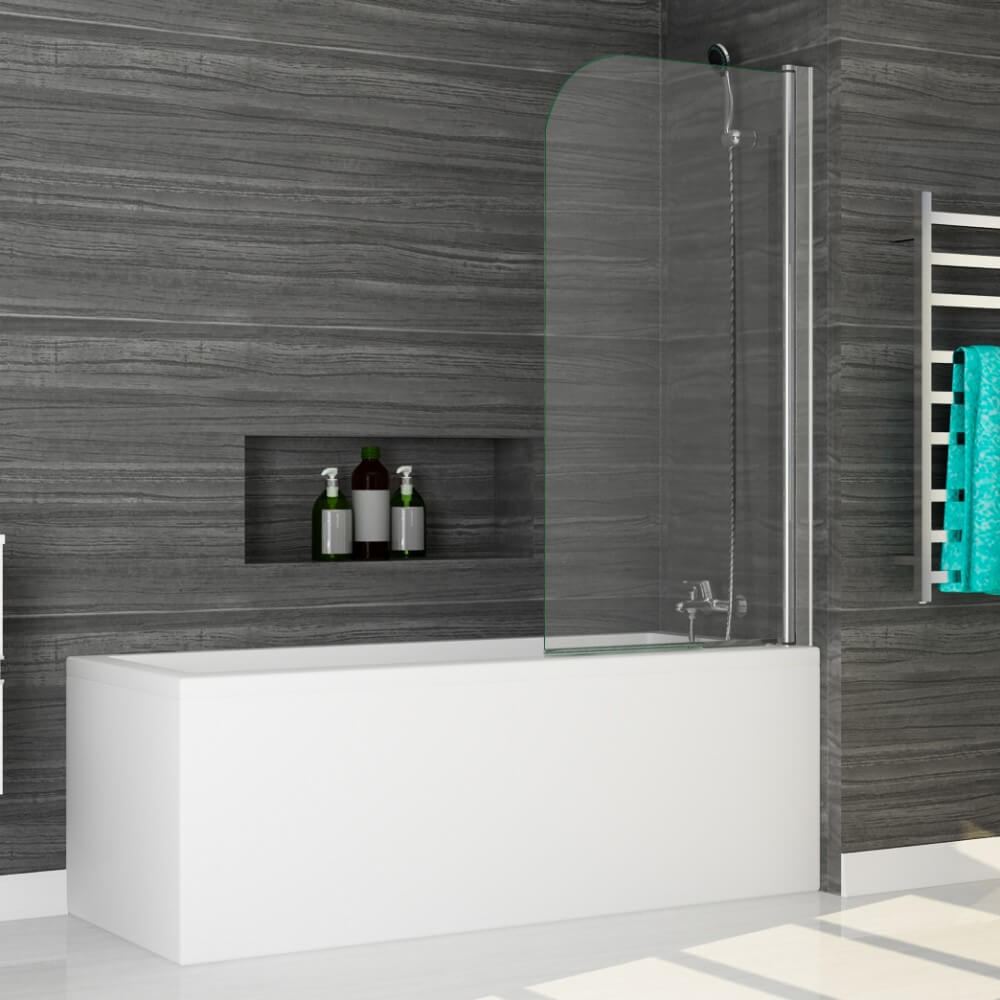

Choosing the right over-bath shower screen feels overwhelming when you’re staring at a tape measure and a dozen product listings. One wrong size and you’ll have water all over your bathroom floor. Get it right, and you’ll enjoy a sleek, splash-free shower over your bath for years.
This complete guide answers the most common question Australian homeowners ask: “What size over-bath shower screen do I need?” We’ll cover Australian standard sizes, how to measure your bath and wall space accurately, the meaning of ‘overlap range’ for sliding screens, and how glass thickness (6mm, 8mm, or 10mm) affects stability. By the end, you’ll know exactly which screen to order for your bathroom renovation or DIY project.
Let’s start with the numbers that matter most.

What Are the Standard Over-Bath Shower Screen Sizes in Australia?
An over-bath shower screen is a glass panel or door mounted directly on the rim of your bathtub. Unlike a full-height shower screen, it sits above the bath to contain splashes while keeping the rest of your bathroom dry.
Standard over-bath shower screen width in Australia ranges from 750 mm to 900 mm, with 800 mm and 900 mm being the most common. Some manufacturers offer 700 mm and 1000 mm widths, but these are less typical.
Standard over-bath shower screen height is usually 1400 mm to 1500 mm measured from the bath rim upward. This height works for most adults while allowing easy access to clean the screen and reach overhead fixtures.
To choose correctly, you must understand your bath tub dimensions. Most Australian baths measure 1500–1700 mm in length and 700–820 mm in width. The screen sits along the width of the bath (the short side), not the length.
Here is a quick reference chart for standard over-bath screen widths:
| Width (mm) | Best for |
|---|---|
| 700 | Very narrow baths, small ensuites |
| 750 | Compact bathrooms, older homes |
| 800 | Most common – standard baths |
| 900 | Wide baths, family bathrooms |
| 1000 | Large freestanding baths |
If your bath width doesn’t match any standard size, don’t worry. Custom screens are always available, though they cost more and take longer to manufacture. Always measure first, then check standard sizes – you might be surprised what fits.
How to Measure Your Bath and Wall Space Accurately
Accurate measurement is the single most important step. Even a 5 mm error can ruin the fit. Follow this step‑by‑step process exactly.
Tools you need: metal tape measure (fabric tapes stretch), spirit level, notepad, pencil, and a step ladder.
Step 1 – Measure width at three points
Place the tape measure on the bath rim against the wall. Measure from the left wall to the right wall where the screen will sit. Take measurements at the front edge of the bath rim, the middle, and the back edge near the wall. Walls and bath rims are rarely perfectly straight. Use the smallest of the three measurements as your working width.
Step 2 – Measure height
Decide how tall you want the screen. Most people choose 1400 mm or 1500 mm above the bath rim. Measure from the bath rim up to the desired height at both the left and right ends. If the bath rim is uneven, use the lower measurement and add adjustable wall channels.
Step 3 – Check for level
Place a spirit level along the bath rim (front to back) and across the width. Then check the walls for plumb (vertical level). If the bath rim slopes more than 5 mm over 800 mm, you may need a professional installer.
Step 4 – Final check
Write all measurements in millimetres (mm). Double‑check every number. Measure twice – order once.
Pro tip: Always measure after tiling is complete. A measurement taken on bare walls or an uninstalled bath will be wrong.

Understanding the ‘Overlap Range’ for Sliding Shower Screens
If you’re buying a sliding over-bath screen, you will encounter the term overlap range. This is one of the most misunderstood concepts, so let’s clarify it.
What is overlap range?
Overlap range is the extra width built into a sliding screen kit that allows the two glass panels to slide past each other. This design lets one product fit a range of opening widths without cutting the glass. For example, a screen labelled “1320–1420 mm” has an overlap range of 100 mm.
How to use overlap range
Find your exact bath opening width (from Chapter 2). Then choose a sliding screen whose overlap range contains that number. If your width is 1350 mm, you need a screen with a range that starts at or below 1350 mm and ends at or above 1350 mm – such as 1320–1420 mm.
Why overlap range matters
Without enough overlap, water will spray between the panels. Too much overlap, and the panels won’t slide smoothly or may not fit at all. A correctly matched overlap range ensures:
-
No water leakage between panels
-
Smooth, quiet sliding operation
-
No need for expensive custom glass
Common Australian overlap ranges
-
1320–1420 mm (fits 1350 mm baths)
-
1420–1520 mm (fits 1450 mm baths)
-
1720–1820 mm (fits 1750 mm baths)
Always verify the overlap range on the product specification sheet before ordering.

How Glass Thickness (6mm, 8mm, or 10mm) Affects Stability
Glass thickness directly impacts stability, safety, and the overall feel of your shower screen. In Australia, all shower glass must be toughened safety glass to AS/NZS 2208:1996. But thickness varies.
6mm Glass
Best for: Framed screens, small baths, budget renovations.
Weight: Lightest (approx. 15 kg/m²).
Stability: Moderate – acceptable when supported by a full frame.
Pros: Affordable, easy to handle, widely available.
Cons: Can flex under pressure, less suitable for frameless designs.
8mm Glass
Best for: Semi‑frameless screens, family bathrooms, most Australian homes.
Weight: Moderate (approx. 20 kg/m²).
Stability: Good – minimal flex, feels solid.
Pros: Best balance of cost and performance, stable without a full frame.
Cons: Heavier than 6mm, requires stronger wall fixings.
10mm Glass
Best for: Frameless screens, luxury bathrooms, high-traffic homes.
Weight: Heavy (approx. 25 kg/m²).
Stability: Excellent – virtually no flex, premium feel.
Pros: Extremely stable, elegant frameless look, very durable.
Cons: Expensive, requires professional installation, heavy to handle.
Stability Comparison Table
| Thickness | Flex under hand pressure | Frame required | DIY friendly |
|---|---|---|---|
| 6mm | Moderate | Yes | Yes |
| 8mm | Minimal | Optional (semi‑frameless) | With help |
| 10mm | None | No (frameless) | No – professional only |
Hardware matters
Thicker glass puts more stress on hinges, brackets, and wall anchors. A 10 mm frameless screen needs heavy‑duty hinges rated for the weight. Never mix 10 mm glass with 6 mm hardware – the screen will fail.
Australian standard reminder
Regardless of thickness, all glass must comply with AS/NZS 2208:1996. Look for the certification mark on the glass edge.
Recommendation: For most Australian bathrooms, 8 mm semi‑frameless is the sweet spot. Choose 6 mm only for framed screens. Choose 10 mm only if you want frameless and have a professional installer.

Fixed Panel vs. Sliding vs. Pivot – Which Screen Type Fits Your Bath?
Beyond size, the screen type affects fit, function, and space requirements.
Fixed Panel (Walk‑In)
A single sheet of glass that doesn’t move. Widths typically 900–1000 mm. Best for wide baths where you can step around the panel. Excellent splash control, no moving parts to break. Requires at least 900 mm of clear bath width.
Sliding Screen
Two overlapping glass panels on a track. Ideal for tight bathrooms because the door doesn’t swing outward. Uses overlap range (Chapter 3) to fit variable widths. Best choice for most Australian over‑bath installations.
Pivot (Swinging) Screen
A hinged door that swings open like a traditional door. Requires 600–800 mm of clear space in front of the bath to open fully. Not suitable for narrow bathrooms, but offers a wide opening for easy access.
Quick comparison table
| Type | Best for | Space needed | Difficulty |
|---|---|---|---|
| Fixed panel | Wide baths, minimal moving parts | Wide bath rim | Easy |
| Sliding | Tight bathrooms, variable widths | No swing space | Moderate |
| Pivot | Open bathrooms, easy access | 600mm clearance | Moderate |
Choose sliding screens for most over‑bath situations. They forgive small measurement errors through overlap range.
Australian Standards and Compliance
Understanding and complying with Australian Standards is not just about following rules—it's about ensuring your bathroom renovation is safe, durable, and legally sound. A non-compliant installation can void your home insurance, lead to structural damage, and pose serious safety risks. This chapter details the key regulations for over-bath shower screens and their surrounding waterproofing.
The Glass Standards: AS/NZS 2208 and AS 1288
Every glass panel in an over-bath shower screen must comply with a combination of two primary Australian Standards.
AS/NZS 2208:1996 – Safety Glazing Materials in Buildings is the cornerstone regulation for all safety glass. It dictates that any glass used in a wet area must be Grade A toughened safety glass. This standard outlines the rigorous testing requirements for the glass, ensuring it is heat-treated to be approximately four to five times stronger than ordinary glass of the same thickness. Critically, it mandates that when this glass breaks, it shatters into small, blunt, cube-like granules rather than dangerous, jagged shards, dramatically reducing the risk of severe injury.
AS 1288:2021 – Glass in Buildings: Selection and Installation is the companion standard that works alongside AS/NZS 2208. It provides the rules for how glass is selected and installed for a given application. This includes specifying minimum thicknesses based on a panel's height, width, and total area. For example, a shower screen panel over 2 metres high typically requires glass of at least 8mm in thickness. Together, these standards ensure that from the manufacturing plant to your bathroom wall, the glass is fit for purpose and safe.
Waterproofing: AS 3740 and the National Construction Code (NCC)
The glass is only half the story. The area around your over-bath shower screen must be correctly waterproofed to prevent water from escaping into the building's structure, which can cause rot, mould, and costly defects.
The Australian Standard AS 3740:2021 – Waterproofing of Domestic Wet Areas sets out the minimum requirements for materials, design, and installation. This standard, which is referenced by the National Construction Code (NCC) , is a legal requirement for new buildings and major renovations.
For a shower over a bath, specific rules apply:
-
The walls of the shower area must be waterproofed not less than 1800 mm above the floor.
-
The floor area outside the bath must be waterproofed within a 1500 mm horizontal radius from the shower rose connection. This area must also include a floor waste and a fall of between 1:50 and 1:80 towards that waste.
Waterstops, Seals, and Enclosed Showers
The NCC defines a frameless screen without seals and deflectors as an "unenclosed shower," triggering extensive floor waterproofing requirements. To be deemed an "enclosed shower," a frameless screen must be fitted with seals and deflectors to control water spread. A semi-frameless screen may be deemed enclosed without a seal where panels overlap.
Marking and Professional Licensing
Compliance must be visible. All compliant safety glass should be permanently etched or labelled with the standard number (e.g., AS/NZS 2208) and grade. Do not accept any glass without this marking. Furthermore, while you might install a DIY framed screen, waterproofing work must be carried out by a licensed contractor, who will issue a compliance certificate upon completion. For frameless 10 mm screens, use a licensed glazier to ensure correct installation.
Conclusion
Choosing the right over-bath shower screen comes down to three decisions: correct width and height, understanding overlap range for sliding screens, and selecting the right glass thickness for stability.
Final checklist before purchasing
-
Measured bath width at three points – smallest number is your working width.
-
Measured height from bath rim – checked for level.
-
For sliding screens: confirmed overlap range contains your width.
-
Chosen glass thickness: 6mm (framed, budget), 8mm (semi‑frameless, best value), or 10mm (frameless, professional install).
-
Verified compliance with AS/NZS 2208:1996 and AS 3740 waterproofing.
Measure carefully, respect the overlap range, and choose thickness wisely. If your bath or walls are significantly out of level, call a professional installer. A correctly sized, stable, and compliant over-bath shower screen will give you years of leak‑free, safe use.
Ready to find the perfect screen for your bathroom? For more over‑bath shower screen ideas, detailed size guides, and premium Australian‑compliant solutions, visit Elegant Showers today. Explore their wide range of standard and custom sizes, from 6mm framed screens to 10mm frameless designs, all meeting AS/NZS 2208 standards. Click here to browse the collection: https://www.elegantshowers.com.au/