
Choosing the wrong shower screen door can turn a beautifully renovated bathroom into a daily frustration. A door that blocks the vanity, clashes with the toilet, or disrupts bathroom traffic flow makes even a morning routine feel cramped. With three main contenders—hinged shower screen door, sliding shower screen door, and bi‑fold shower screen door—Australian homeowners often struggle to match the mechanism to their actual layout.
This article helps you decide based on real‑world factors: your bathroom’s physical dimensions, the number of people using it, and how traffic moves past the shower. We’ll compare space‑saving shower screen options, discuss compliance with Australian Standards (AS/NZS 2208), and provide a clear decision matrix. By the end, you’ll know exactly which door type suits your small ensuite, family bathroom, or master suite.
Let’s start by understanding why this choice matters more than aesthetics alone.

How a Shower Screen Door Dictates Daily Traffic Flow
Every shower screen door fundamentally changes how you and your family move through a bathroom. The relationship between the shower screen door and the surrounding fixtures – vanity, toilet, towel rails, and even the bathroom entry door – determines whether your morning routine feels effortless or frustrating. A hinged door needs a clear outward swing – typically 600–800mm of clearance space – which can block pathways and conflict with other fixtures. In a small ensuite, that swing can turn a functional space into an obstacle course: imagine opening the hinged shower screen door only to have it hit the toilet or the vanity drawer you left open. By contrast, sliding and bi-fold doors require zero outward swing, preserving traffic flow even in tight layouts. However, they introduce their own constraints, such as reduced entry width and track maintenance. Understanding your bathroom’s daily traffic patterns – who uses it, when, and what movements are most common – is the first step to choosing the right shower screen door.
Measuring Your Space: Clearance, Door Swing, and Corner Configurations
Before you even look at product catalogues, grab a tape measure, a notepad, and possibly a roll of painter’s tape. Follow this step‑by‑step measuring guide:
Step 1: Measure the shower opening width
Standard Australian shower openings range from 600mm to 900mm for alcove showers, and 700mm to 1000mm for corner or neo‑angle showers. Write this number down.
Step 2: Determine the swing zone available
Stand directly in front of the shower opening. Measure the unobstructed floor space extending outward from the opening. This is the clearance space needed for a hinged door. For a 700mm hinged shower screen door, you need at least 700mm of clear floor space – no vanities, toilets, towel rails, or walls within that zone. If that zone has less than the door’s width, a hinged door will not work safely or conveniently.
Step 3: Check for obstacles around the shower
Note the position of every fixture within 1 metre of the shower opening. Use painter’s tape on the floor to simulate the arc of a hinged door – open an imaginary door to see what it would hit. Common conflict points include:
-
Toilets placed too close (less than 600mm from the shower opening)
-
Vanities with drawers that protrude
-
Heated towel rails mounted on the adjacent wall
-
The bathroom’s own swing door
Step 4: Identify your shower’s configuration
-
Alcove shower: Three walls, one open side. Usually the easiest to fit any door type, but the open side determines the swing direction.
-
Corner shower: Two walls meeting at a corner, with two glass panels forming a square or neo‑angle shape. Sliding or bi‑fold doors are most common here because a hinged door would swing into the room awkwardly.
-
Walk‑in shower (wet room): No door at all, but if you want a door, a sliding door mounted on a fixed glass panel is typical.
Step 5: Consider Australian Standards (AS/NZS 2208)
Australian Standards require that any outward‑swinging shower screen door must not strike other fixtures. If the door would hit a toilet or vanity within its swing arc, that installation does not comply. Additionally, the glass must be toughened safety glass with a permanent certification mark.
Detailed Comparison: Hinged vs. Sliding vs. Bi-Fold Shower Screen Doors
| Feature | Hinged | Sliding | Bi‑Fold |
|---|---|---|---|
| Space‑saving rating | 6/10 | 10/10 | 10/10 |
| Swing clearance needed | 600–700mm | None | None (folded depth only) |
| Effective entry width | Full door width | Half door width | Nearly full opening |
| Maintenance (ease) | Easiest – open fully to clean | Harder – tracks trap dirt | Moderate – more hinge gaps |
| Water containment | Excellent tight seal | Good with proper seals | Good with magnetic strips |
| Best for layout | Large bathrooms | Compact, narrow, family bathrooms | Extremely tight spaces |
| Aesthetic | Classic, traditional | Modern, minimalist | Contemporary, functional |
| Typical glass thickness | 8–10mm | 6–8mm | 6mm |
| Australian Standard compliance | Yes – outward opening | Yes | Yes |

Hinged Shower Screen Door Explained: How It Works and Where It Shines
A hinged shower screen door attaches to a fixed side panel or directly to the wall via two or three hinges. When you pull the handle, the door swings outward like a standard room door. This mechanism is simple, robust, and timeless. Hinged doors shine in larger bathrooms, spacious alcoves, or ensuites where floor space is not a constraint. They are the go-to choice for homeowners who want a wide opening – often the full width of the shower – for easy entry and exit.
What Is a Hinged Shower Screen Door?
A hinged shower screen door attaches to a wall or fixed glass panel via two or more hinges, swinging open like a standard doorway. It can be frameless or semi‑frameless and typically uses a magnetic latch to seal.
Pros and Cons of Hinged Doors for Australian Bathrooms
Pros:
-
Provides a wide opening (up to the full shower width) for effortless access.
-
Extremely easy to clean – no tracks, no nooks, just smooth glass on both sides.
-
Delivers a classic, frameless modern minimalist style that elevates any bathroom’s aesthetic.
-
Fewer moving parts than bi-fold or sliding doors, meaning less maintenance over time.
Cons:
-
Requires significant clearance space – at least the door’s width in front of the shower.
-
Can obstruct other bathroom fixtures if the bathroom layout is cramped.
-
May allow slight water leakage if the magnetic seals or door sweep degrade over time.
-
Not suitable for narrow bathrooms or ensuites where every centimetre counts.
Hinged vs. Pivot Shower Screen Door: What’s the Difference?
Many Australians confuse hinged and pivot doors. A true hinged shower screen door uses side-mounted hinges, swinging entirely outward. A pivot shower screen door rotates on top and bottom pins, often swinging both inward and outward (dual-action). The key difference: pivot doors generally need less clearance space because the pivot point is centred, reducing the arc of the swing. If you love the look of a hinged door but your clearance space is tight (e.g., 500mm instead of 700mm), a pivot shower screen door could be your perfect compromise.

Sliding Shower Screen Door Explained: How It Works and Where It Shines
A sliding shower screen door features two or three glass panels that glide horizontally along a sliding track system mounted at the top and bottom. One panel remains fixed (the “stationary” panel), while the other(s) roll on smooth nylon or stainless steel rollers. Because there is no outward swing, sliding doors require zero floor clearance. They are the undisputed champion of space-saving design, ideal for small bathrooms, narrow ensuites, and corner shower layouts where every millimetre matters. In Australian apartments, where bathrooms often measure just 1.8m x 2.0m, a sliding door is often the only viable option – it allows the shower to be placed directly next to the toilet or vanity without any conflict.
What Is a Sliding Shower Screen Door?
A sliding door moves horizontally along a top or bottom track system. Typically, one panel remains fixed while the other glides past it—or both panels slide in a bypass arrangement.
Types of Sliding Mechanisms: Top‑Hung vs. Bottom‑Roller Systems
Not all sliding doors are created equal. There are two main track configurations:
-
Bottom‑roller sliding doors: The door’s weight rests on rollers inside a bottom sliding door track. This is common in budget‑friendly framed sliding screens. While easy to install, the bottom track collects water, soap scum, and hair, requiring frequent cleaning. Over time, rollers can rust or clog.
-
Top‑hung sliding doors: The door hangs from a concealed top track, with a guiding rail at the bottom only for stability. This design keeps the bottom track nearly flush with the floor, dramatically reducing dirt buildup. Top‑hung systems offer smoother operation and longer life, but they are more expensive and require a structurally sound ceiling or header. For Australian homeowners wanting the best space‑saving shower door with minimal maintenance, a top‑hung sliding door is the premium choice.
Pros and Cons of Sliding Doors for Contemporary Australian Bathrooms
Pros:
-
Ultimate space-saving design – no swing zone needed; the door moves entirely within the shower footprint.
-
Smooth, quiet operation with quality rollers – you can open the door without disturbing others.
-
Versatile modern aesthetic that suits contemporary Australian bathrooms, from beachside shacks to city penthouses.
-
Available in framed, semi-frameless, and fully frameless options to match any budget and style.
-
Works beautifully with corner shower enclosures, alcoves, and even curved or neo‑angle showers.
-
Generally more affordable than hinged frameless doors of equivalent glass thickness, because the framing adds rigidity.
Cons:
-
Provides a limited opening – typically only half the total width (e.g., a 700mm sliding door opens to only 350mm). This can feel cramped for larger adults.
-
The sliding door track at the bottom (or top/bottom combination) collects soap scum, hair, and grime, requiring regular shower screen door cleaning. If neglected, tracks can become breeding grounds for mould.
-
Rollers can wear out over time, needing replacement every 5–10 years depending on usage. Cheap nylon rollers may last only 2–3 years in hard water areas.
-
Less accessible for people with mobility aids (walkers, wheelchairs) due to the narrow entry.
-
Water containment can be weaker than hinged doors because the overlapping panels rely on seals that can degrade, leading to small water leakage onto the floor.
The Rise of the Semi-Frameless Sliding Shower Screen in Australia
In recent years, the semi-frameless sliding shower screen has exploded in popularity across Australia. Why? It offers the durability and lower cost of a framed system (aluminium frames around the perimeter) combined with a more minimalist, modern look that mimics frameless glass. The frames add rigidity, reducing glass vibration during sliding, while the reduced frame thickness (often 25–30mm) maximises glass visibility. For homeowners wanting a space-saving shower door without the premium price of fully frameless glass, semi-frameless is an excellent choice. Brands like Australian Shower Screens and Elegant Showers report that semi‑frameless sliding doors now account for over 40% of their small‑bathroom sales. The key is to choose a model with a flush‑fitting bottom track and high‑quality stainless steel rollers to minimise maintenance headaches.

Bi-Fold Shower Screen Door Explained: How It Works and Where It Shines
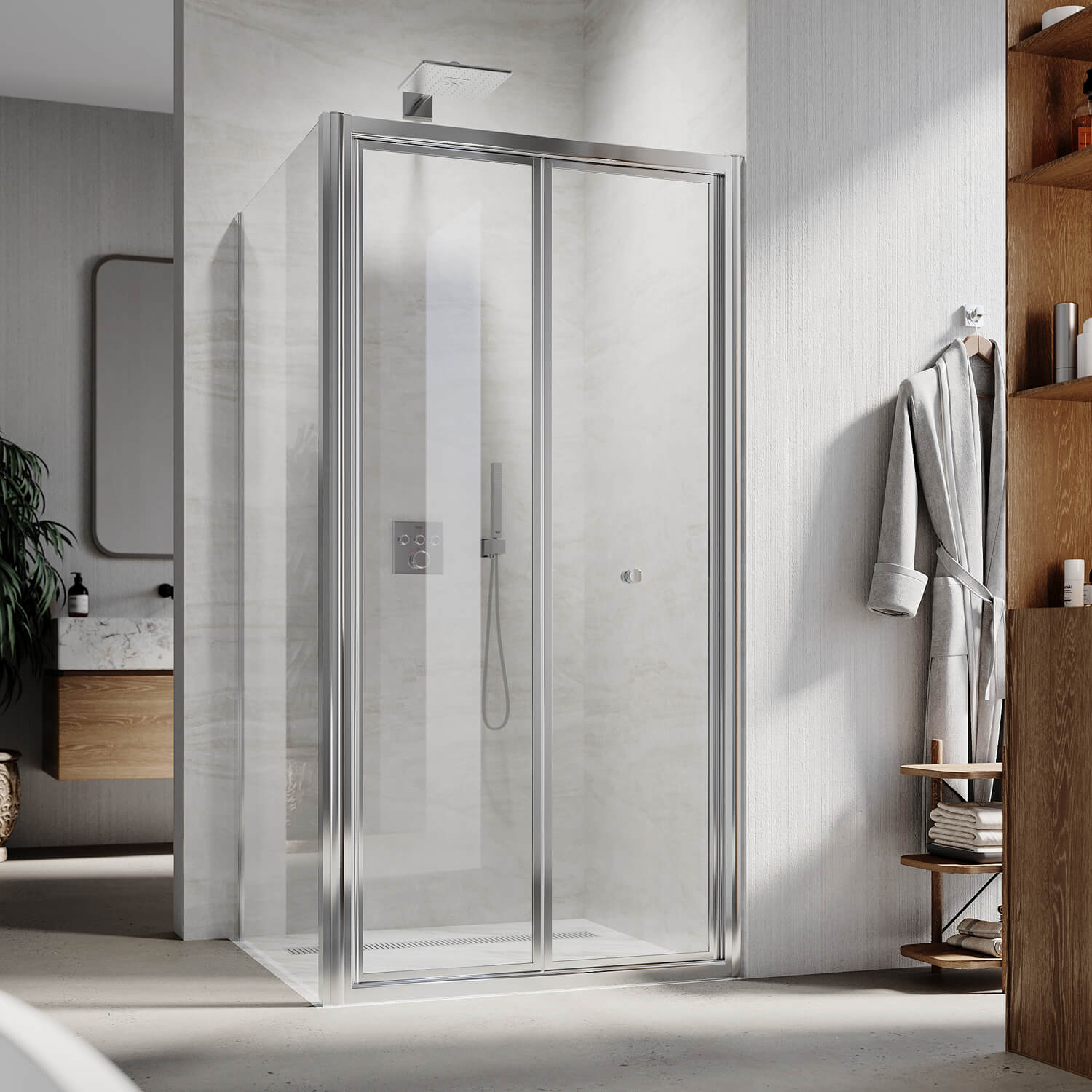
A bi-fold shower screen door consists of two or three narrow glass panels connected by vertical hinges. As you push the door open, the panels fold inwards like an accordion, stacking neatly against the fixed side panel or wall. This ingenious mechanism requires no outward swing and, when fully open, takes up minimal space. Bi-fold doors shine in extremely tight spaces where a sliding door cannot provide a sufficiently wide entry and a hinged door is impossible. They are the saviour of awkward bathroom layouts.
Pros and Cons of Bi-Fold Doors in Australian Homes
Pros:
-
The most space-saving shower door when open – the folded stack protrudes only 100–150mm into the bathroom.
-
Provides a wider entry than a sliding door of the same total width. For example, a 700mm bi-fold door opens to approximately 500–550mm (because the folded panels reduce the effective opening), compared to only 350mm for a sliding door.
-
Can be installed in very narrow hallways or where a sliding door track cannot fit.
-
Often more affordable than comparable sliding or frameless hinged doors.
Cons:
-
More mechanical complexity – multiple hinges, pivot points, and seals create potential failure points.
-
The folding action creates nooks and crevices where moisture and soap scum accumulate, making bi-fold shower screen cleaning more tedious.
-
The bi-fold door can feel less solid and more “rattly” than a hinged or sliding door due to the multiple joints.
-
Hinges may sag over time if not properly maintained, leading to misalignment and water leakage.
How to Match Shower Screen Door Type to Your Bathroom Layout
Matching the correct shower screen door to your specific bathroom layout is not guesswork—it is a systematic process of measuring dimensions, identifying obstacles, and studying how people move through the space. Below are five common Australian bathroom layouts with precise recommendations for hinged, sliding, or bi‑fold shower screen doors.
Small Ensuite Bathrooms / Narrow Bathrooms
In a typical Australian ensuite measuring 1.8m x 2.0m, the shower is often tucked into a corner or against one wall. Measure the clearance directly in front of the shower opening. If this distance is less than 600mm, a hinged shower screen door is impossible—it will strike the vanity or toilet. Instead, choose a sliding shower screen door (preferred) or a bi‑fold shower screen door (if the opening width is very tight). Sliding doors preserve every centimetre of floor space, allowing two people to pass comfortably. For ensuites under 3.5m², sliding is the default winner in 80% of cases.
Large Master Bathrooms / Open‑Plan Layouts
Master bathrooms often feature a freestanding bath, double vanity, and generous floor area. Here, a hinged shower screen door (preferably frameless with 10mm glass) delivers a luxurious, hotel‑like experience. The full‑width opening makes entry effortless, and there is ample clearance for the swing radius (600–700mm). If the shower is in a corner, consider a pivot door—a type of hinged door that rotates on a central axis, requiring slightly less projection. Avoid sliding doors in large bathrooms; they look disproportionate and their reduced entry width feels unnecessary.
Corner Shower Installations (Quadrant & Neo‑Angle)
Corner showers typically use quadrant (curved) or neo‑angle (angled) enclosures. For a quadrant shower with a curved front, a sliding shower screen door is nearly always the best match because the curved track guides the door smoothly around the radius. For neo‑angle enclosures, you have two choices: bi‑fold (if the two angled panels meet at a 90° corner) or sliding (if one side is fixed). A hinged door rarely works in corner setups because the swing would collide with the angled walls. Always request a curved or angled track system that is pre‑cut to your shower’s exact degree.
Wall‑to‑Wall / Alcove Showers
An alcove shower has three walls (left, back, right) and an open front. This is the most flexible layout. The decision depends entirely on clearance in front of the alcove.
-
Clearance >700mm: Hinged door gives the best water seal and widest entry.
-
Clearance 400–700mm: Sliding door – zero swing intrusion.
-
Clearance <400mm with door directly opposite a vanity: Bi‑fold door – the folded panels consume only 150mm inside the shower.
Additionally, consider traffic flow: if the alcove faces a hallway or bedroom door, sliding or bi‑fold prevents the door from swinging into that pathway.
Walk‑In Panels as a Door‑Free Alternative
For ultra‑modern or mobility‑focused bathrooms, a fixed glass panel (no moving door) paired with a slightly sloped floor and a well‑positioned showerhead can replace all three door types. This works only when the shower is long enough (≥1200mm) to prevent splash beyond a 900mm opening. It excels in high‑traffic ensuites where eliminating a door mechanism simplifies cleaning and accessibility.
Bathrooms with External Obstacles (Doors, Radiators, Heated Towel Rails)
Always map the swing path of a hinged door against any external obstacle. If a towel rail or bathroom entry door sits within the swing radius, switch to sliding or bi‑fold. This simple check avoids costly installation failures.
Decision Matrix: Quick Reference Table
Use the decision matrix below to match your specific needs to the best shower screen door type. Each row represents a common household scenario or layout constraint. The recommended door type is listed with a brief justification.
| Decision Criteria | Hinged Shower Screen Door | Sliding Shower Screen Door | Bi‑Fold Shower Screen Door | Best Choice |
|---|---|---|---|---|
| Available clearance in front of shower | Needs ≥600mm swing radius | Zero clearance required | Zero clearance (needs only 150mm inside shower) | Sliding (most versatile) |
| Number of people using bathroom daily | 1–2 people (low traffic) | 2–5 people (medium to high traffic) | 1–3 people (low to medium traffic) | Sliding for families |
| Bathroom total floor area | >5m² | 2.5–5m² | 1.5–4m² | Sliding for most; Bi‑Fold for very small |
| Presence of young children (safety priority) | Risk of swinging door hitting child | No swing hazard – safest | No swing hazard – safe but pinch points at hinges | Sliding |
| User with mobility aids (wheelchair/walker) | Widest opening (700–800mm) – best if outward‑opening | Reduced entry (~600mm) – may not suit larger chairs | Folded panels create uneven edge – not ideal | Hinged (outward) |
| Ease of cleaning (priority) | Easiest – full access to glass and walls | Hardest – tracks trap soap scum | Moderate – more hinge gaps | Hinged |
| Water containment (leak prevention) | Excellent – continuous magnetic seal | Good – seals can wear at track ends | Good – magnetic strips require yearly adjustment | Hinged |
| Aesthetic preference | Classic, traditional, or frameless luxury | Modern, minimalist, space‑saving | Contemporary, functional, compact | Personal choice – frameless sliding is most popular |
| Budget (supply only, AUD) | 1,100+ | 1,200+ | 1,200 | Bi‑Fold (lowest entry price) |
| Australian Standards compliance | Must be outward or dual‑action (NCC 2022) | Fully compliant | Fully compliant | All compliant when installed correctly |
| Coastal home (corrosion risk) | Hinges exposed – need marine‑grade stainless steel | Tracks vulnerable – require regular cleaning | Multiple hinges – higher maintenance | Hinged (fewer moving parts with marine hardware) |
Making the Final Choice Between Hinged, Sliding, and Bi-Fold Doors
Choose a hinged shower screen door for large, open bathrooms with ample clearance space and a desire for easy cleaning. Choose a sliding shower screen door for tight layouts where space saving is paramount and you can commit to track maintenance. Choose a bi-fold shower screen door for the most space‑conscious entry with a wider opening than a slider. Always prioritise your bathroom layout and traffic flow above all else. For more shower screen door ideas and solutions, including installation guides and product comparisons, visit Elegant Showers Australia at https://www.elegantshowers.com.au/ – your trusted resource for quality bathroom renovations.